What if your drawings aren’t improving because you’re practicing the wrong things?
Most beginners spend hours copying finished artwork, hoping skill will appear through repetition. But faster progress comes from simple drawing exercises that train your eyes, hands, and decision-making with purpose.
The right drills can sharpen your line control, improve proportions, build confidence, and help you sketch more naturally-even if you only have 10 minutes a day.
In this guide, you’ll discover easy drawing exercises that turn practice into real, visible improvement instead of frustrating guesswork.
Why Simple Drawing Exercises Build Core Skills Faster Than Finished Artwork
Simple drawing exercises improve your skills faster because they isolate one problem at a time. When you practice straight lines, ellipses, shading gradients, or quick gesture drawings, your brain gets clear feedback without the pressure of making a polished piece look “portfolio-ready.” That focused repetition builds muscle memory, hand control, and visual accuracy more efficiently than spending hours correcting one finished artwork.
In real studio practice, artists often warm up with basic drills before opening Procreate, Photoshop, or a sketchbook. For example, drawing 50 loose circles on a digital drawing tablet helps you understand wrist movement, pen pressure, and shape consistency before you attempt a character portrait or product illustration. It feels small, but it directly affects the quality of your final work.
- Line drills improve confident strokes for outlines, comics, and concept art.
- Value scales train shading control, useful for realistic drawing and digital painting.
- Gesture sketches build speed and proportion for figure drawing classes or animation practice.
Finished artwork is still important, but it often mixes too many skills at once: composition, anatomy, lighting, color, texture, and software technique. If something looks wrong, it can be hard to know whether the issue is your drawing foundation, your tool settings, or your reference choice. Short exercises make the weak point obvious, which saves time and reduces frustration.
A practical approach is to spend 10-15 minutes on exercises before working on a larger piece. This works whether you use cheap printer paper, a sketchbook, or a professional tablet like a Wacom. Small drills create cleaner habits, and cleaner habits make finished artwork easier.
Daily Drawing Drills for Improving Line Control, Shapes, Shading, and Observation
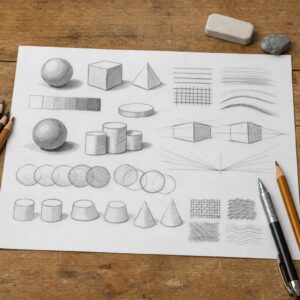
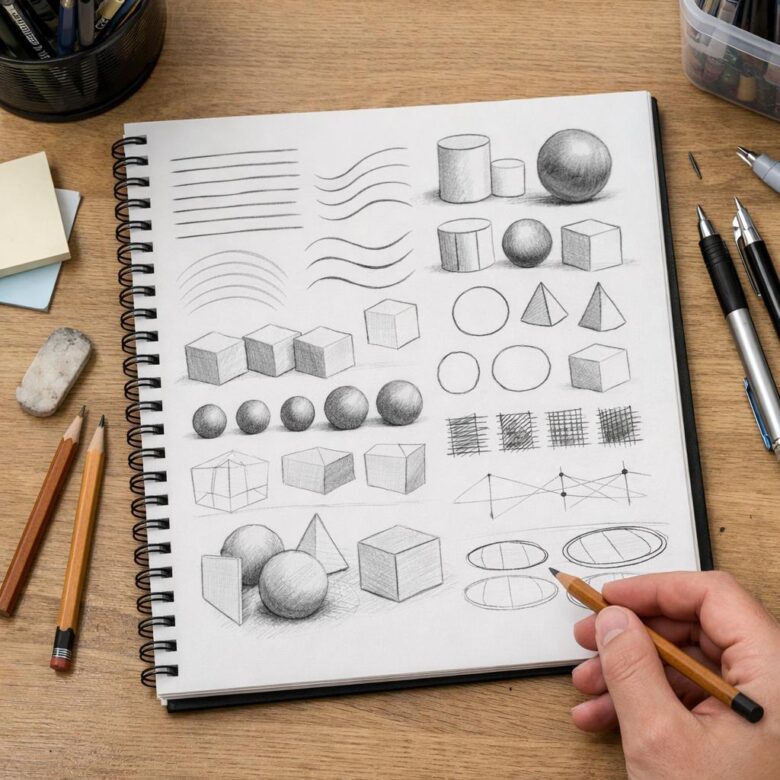
A focused 20-minute routine can improve your drawing skills faster than random sketching for hours. Start with line control: draw straight lines, curved lines, ellipses, and boxes without rushing, using a sketchbook, mechanical pencil, or a drawing tablet like a Wacom. The goal is not perfect lines-it is steady pressure, cleaner direction, and fewer scratchy marks.
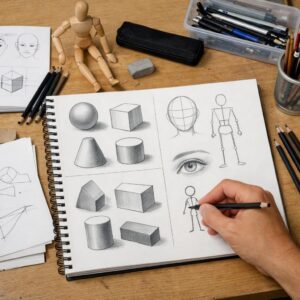
Next, practice basic shapes because most realistic drawing, character design, and digital illustration depend on them. Draw cubes, cylinders, spheres, and cones from different angles, then turn them into simple objects like a mug, phone, shoe, or desk lamp. This builds the kind of structure you need for portfolio work, online art classes, and professional illustration software such as Procreate or Adobe Photoshop.
- 5 minutes: Lines, circles, ellipses, and confident strokes.
- 7 minutes: Shape construction using boxes, cylinders, and spheres.
- 8 minutes: Shading and observation from one real object nearby.
For shading, choose one light source and create five values from light gray to dark. A real-world example: place an apple near a desk lamp and draw the cast shadow, reflected light, and darkest contact area under the fruit. This teaches you more than copying a flat reference because your eyes learn to compare edges, contrast, and depth in real time.
Keep these drills dated so you can review progress weekly. In practice, small corrections-lighter grip, slower curves, cleaner shadow edges-often make the biggest difference.
Common Practice Mistakes That Slow Your Drawing Progress-and How to Fix Them
One of the biggest mistakes is practicing without a clear target. Filling a sketchbook with random faces, hands, or characters can feel productive, but if you never isolate the weak point-proportion, line control, perspective, or shading-you repeat the same errors for months.
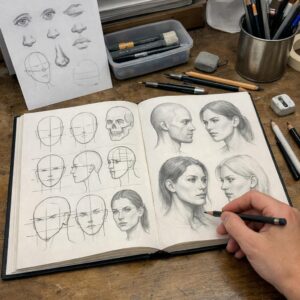
A better approach is to set a small goal before each session. For example, instead of “practice anatomy,” try “draw 20 hands focusing only on thumb placement,” then compare them with photo references or a structured online drawing course.
- Rushing into details: Start with simple shapes and construction lines before adding eyelashes, texture, or clothing folds.
- Ignoring feedback: Use communities like Proko or Discord art groups to get critique instead of relying only on personal judgment.
- Using expensive tools as a shortcut: A digital drawing tablet, iPad, or premium drawing software helps workflow, but it will not replace fundamentals.
Another common issue is practicing too long without reviewing your work. In real studio habits, artists often keep old sketches visible because it reveals patterns: tilted eyes, stiff poses, muddy values, or overworked lines.
Try a simple review system every week. Pick three drawings, mark one thing that improved and one thing to fix, then design your next drawing exercises around that specific problem.
If you use tools like Procreate, Wacom, or Photoshop, take advantage of layers to separate rough sketch, clean line art, and values. This makes mistakes easier to diagnose and lowers the cost of wasted time, especially if you are building a portfolio for freelance illustration, concept art, or online commissions.
Final Thoughts on Easy Drawing Exercises That Improve Your Skills Faster
Improving at drawing is less about waiting for inspiration and more about building a repeatable habit. Choose a few exercises that target your weakest areas, practice them consistently, and track what changes over time.
The best approach is simple: start small, stay focused, and avoid rushing into complex work before your fundamentals are steady. If an exercise feels slightly challenging but still manageable, it is probably the right one. With regular practice, even short sessions can sharpen your observation, control, and confidence faster than occasional long drawing marathons.